


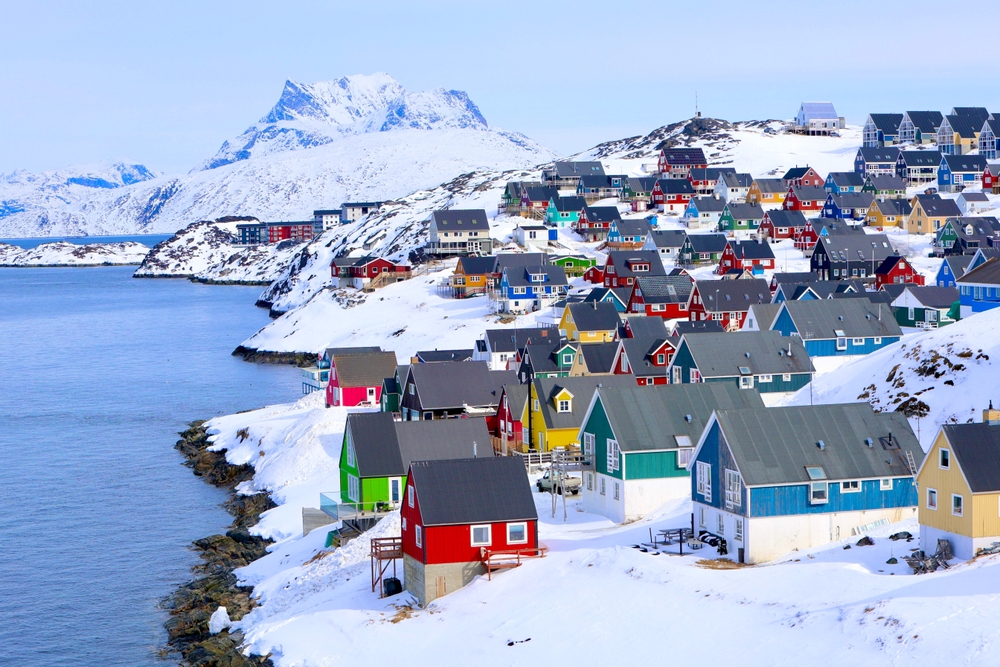
Greenland, the vast Arctic island northeast of Canada, has re-emerged as a flashpoint in global politics after the White House said the use of U.S. military force remains an option in President Donald Trump’s renewed push to bring the territory under American control.
The comments have sparked strong reactions across Europe and North America, with allies reaffirming that Greenland’s future lies solely in the hands of its people and Denmark, which governs the self-ruled territory.
White House Keeps Military Option on the Table
White House press secretary Karoline Leavitt said President Trump views Greenland as a critical national security priority, citing rising competition in the Arctic from China and Russia.
“The president and his team are discussing a range of options to pursue this important foreign policy goal,” Leavitt said, adding that the use of the U.S. military is “always an option” available to the commander in chief.
Trump first floated the idea of purchasing Greenland during his initial term, but the issue has gained renewed urgency following a recent U.S. military operation involving Venezuela. While some senior administration figures, including special envoy to Greenland Jeff Landry and deputy chief of staff Stephen Miller, have downplayed the likelihood of military action, the White House has not ruled it out.
Republican House Speaker Mike Johnson also distanced himself from the idea, saying he does not believe military force would be appropriate.
Allies Push Back and Defend Greenland’s Sovereignty
European leaders moved quickly to reject Washington’s rhetoric. France, Germany, Italy, Poland, Spain and the United Kingdom joined Danish Prime Minister Mette Frederiksen in issuing a statement affirming that Greenland “belongs to its people.”
The statement underscored that Greenland is a self-governing territory within the Kingdom of Denmark and part of the NATO alliance, stressing that only Denmark and Greenland have the authority to decide the island’s future.
Canadian Prime Minister Mark Carney echoed that position and announced an upcoming visit to Greenland by Canada’s Governor General Mary Simon and Foreign Minister Anita Anand. Standing alongside Frederiksen in Paris, Carney said Greenland’s future must be determined exclusively by the people of Denmark and Greenland.
Despite the pushback, Louisiana Governor Jeff Landry, recently appointed by Trump as U.S. special envoy to Greenland, said he has little interest in engaging with Danish or European officials. Instead, he said he wants to speak directly with Greenlanders, claiming they are eager for economic opportunities and closer ties with the United States.
Why Greenland Matters Strategically
Greenland’s strategic importance has long made it central to North American defense planning. More than two-thirds of its territory lies within the Arctic Circle, a region that has grown increasingly important as climate change opens new shipping routes and access to natural resources.
The United States operates the Pituffik Space Base in northwestern Greenland, a key installation supporting missile warning, missile defense and space surveillance for both the U.S. and NATO. Greenland also sits along the GIUK Gap, a critical chokepoint where NATO monitors Russian naval movements in the North Atlantic.
Beyond military considerations, Greenland is rich in rare earth minerals vital for modern technology, renewable energy systems and electric vehicles. The U.S. Geological Survey has also identified potential offshore oil and natural gas reserves.
While Trump argues that U.S. control is necessary to counter Russian and Chinese activity in the Arctic, both Denmark and Greenland’s leadership have firmly rejected any takeover. Greenland’s current self-rule arrangement, expanded in 2009, also recognizes the island’s legal right to independence, an option supported by many Greenlanders.
For now, Greenland remains firmly outside U.S. control, but Washington’s increasingly blunt language has ensured the island will stay at the center of geopolitical debate.

