


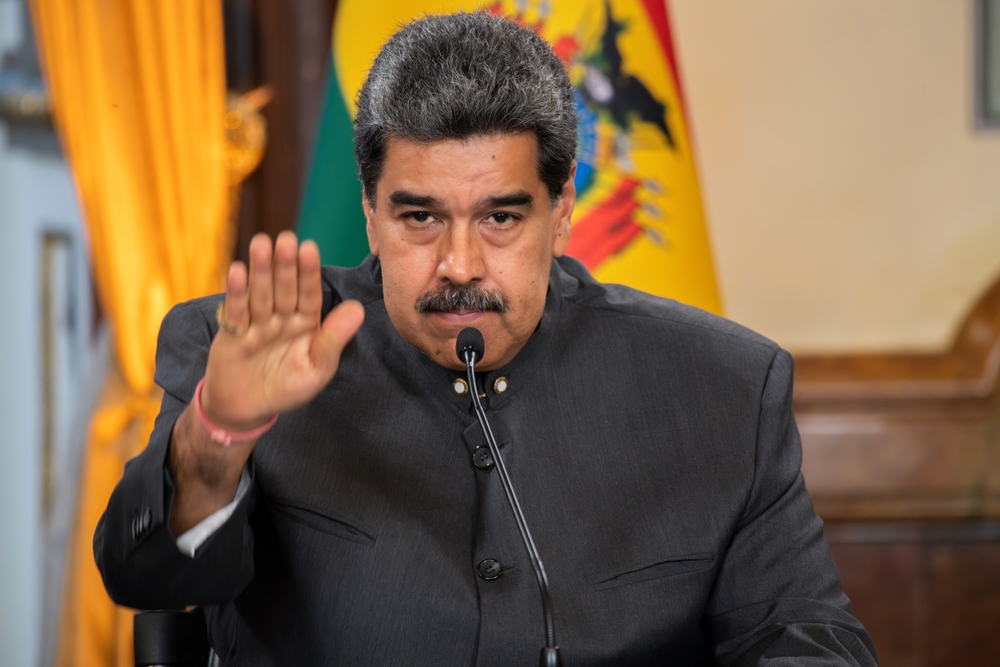
In a dramatic move that caught governments and analysts off guard, US forces arrested Venezuelan President Nicolás Maduro and his wife, Cilia Flores, in Caracas and transported them to New York to face criminal charges. The operation, involving multiple branches of the US military, marks one of the most aggressive foreign interventions by Washington in decades.
Speaking from his Mar-a-Lago resort in Florida on Saturday, President Donald Trump said the United States would assume temporary control of Venezuela while a transition is arranged. He offered few specifics but framed the move as necessary to prevent further instability.
“We are going to run the country until such time as we can do a safe, proper and judicious transition,” Trump said. “We can’t take a chance that somebody else takes over Venezuela that doesn’t have the good of the Venezuelan people in mind.”
Trump outlines interim US role
Trump said the US would oversee Venezuela’s administration with the help of senior officials, gesturing to Secretary of State Marco Rubio, Defence Secretary Pete Hegseth, and Chairman of the Joint Chiefs of Staff General Dan Caine during the announcement. He said “various people” would be designated to manage different aspects of governance, though he did not explain how that process would work in practice.
At one point, Trump claimed that Venezuelan Vice President Delcy Rodríguez had been sworn in as Maduro’s successor and was willing to cooperate with US plans. However, Venezuelan authorities have made no such announcement, adding to confusion surrounding the situation.
Trump also suggested that further military action remained on the table. “We’re not afraid of boots on the ground,” he said, adding that US oil companies would be invited to invest billions of dollars to repair Venezuela’s damaged oil infrastructure. “And we are ready to stage a second and much larger attack, if we need to do so.”
Legal justification and secrecy questioned
US officials defended the operation as a law enforcement action rather than a military invasion. Rubio said congressional approval was not required, arguing that Maduro was already under US indictment and considered a fugitive.
“Nicolás Maduro was indicted in 2020 in the United States. He is not the legitimate president of Venezuela,” Rubio said. He added that Maduro carried a $50 million US reward, joking that the arrest meant Washington would no longer need to pay it.
Trump suggested Congress had not been informed in advance because of fears the plan could leak, potentially jeopardizing the mission.
That explanation did little to satisfy critics. Democratic Senator Mark Warner warned that the arrest set a dangerous precedent. “If the United States asserts the right to use military force to capture foreign leaders it accuses of crimes, what stops other powers from doing the same?” he said, pointing to China and Russia as potential examples.
Warner also accused the administration of hypocrisy, noting Trump’s earlier pardon of former Honduran President Juan Orlando Hernández, who had been convicted in a US court on drug trafficking charges.
Praise, concern, and uncertainty ahead
Republicans in Congress largely backed Trump’s actions. Senator Roger Wicker, chair of the Senate Armed Services Committee, praised the operation as the result of months of effort to weaken criminal networks linked to Maduro’s government. He said Venezuelans now had an opportunity to move toward peace and stability.
Analysts, however, warned that the consequences could be severe. Daniel DePetris of the Defense Priorities think tank said the arrest could trigger unintended outcomes, including divisions within Venezuela’s military, the expansion of criminal groups, or even civil war.
“Whether this change proves positive or disastrous in the long run remains to be seen,” DePetris said. “None of the plausible scenarios would be good for regional stability or US interests.”
He also questioned Washington’s shifting rationale for targeting Maduro, which has ranged from fighting drug trafficking and reclaiming oil assets to promoting democracy. “Venezuela is not a rising threat,” DePetris said. “It’s a bankrupt state whose economy has collapsed over the last decade.”
As the world reacts, Venezuela now faces a period of deep uncertainty, with its leadership detained abroad and its future increasingly shaped by decisions made in Washington.

